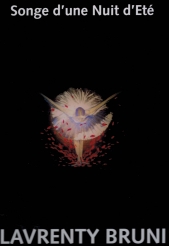
Lavrenty Bruni - A Midsummer Night's Dream
June 2014
Lavrenty Bruni, Crépuscule, 2013, oil on canvas, 170 x 170 cm
Lavrenty Bruni, Camelia, 2012, oil on canvas, 200 x 100 cm
Lavrenty Bruni, Anémone, 2012, oil on canvas, 200 x 100 cm
Lavrenty Bruni, Belle de nuit, 2014, oil on canvas, 200 x 70 cm
Lavrenty Bruni, Hortensia, 2014, oil on canvas, 200 x 100 cm
Lavrenty Bruni, Pivoine, 2014, oil on canvas, 140,5 x 180 cm
Lavrenty Bruni, Vent rouge, 2012, oil on canvas, 155,5 x 200 cm
Born into an artistic dynasty, Lavrenty Bruni is a painter based in Moscow, Russia.
His aristocratic family, whose ancestors came from Mendrisio (Ticino, the Italian speaking part of Switzerland) and emigrated to the Tsarist Empire in the 18th Century, has produced at least one painter in every generation. Lavrenty Bruni completed his studies of classical painting and drawing at the University of Moscow. He exhibits in solo and group shows and has works in private collections worldwide, including Australia, Japan, The United States of America, The United Kingdom, Russia, Hong Kong, Israel, South Africa, France, and Belgium.
Lavrenty Bruni raises the woman, the ballerina, as the unique protagnonist of his paintings and drawings. Her individuality is erased, and her face rarely identifiable. She symbolizes grace, lightness, refinement. The muscular body manages to express a trembling fragility, just like flower petals. Tulle offers a particulary interesting field of exploration by its volume, material, white transparency, and quiver effects frozen by the brush. The absence of scenery attracts all the attention to the dancer's figure itslef. On ochre, blue or black backgrounds, Lavrenty Bruni favours a reduced colour palette, and pale tones. When painting with oils, he especially likes to emphasize his silhouettes with blue highlights, indicating the shaded areas of the body. Sometimes a shower of bright monochrome petals welcomes a curtsy.